I like to cook, although the day-to-day chore of planning an evening meal and preparing it can be a drudgery, day after day after day after day. Still, even though I feel used up sometimes and wish I never had to cook another dinner, I like the general idea of cooking. I get excited at the prospect of cracking open a new cookbook, and proper markets with interesting ingredients from outside the county circle make me want to break out the wooden spoons and strap on my monogrammed apron.
I take certain things for granted--simple ingredients that I buy in jars like cinnamon and capers--and I don't stop to think about what the heck they are. What is a caper, anyway? So, I did a little digging, and here is what I found about certain spices that don't come from the ground in glass containers.
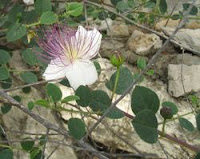 Capers: these are the buds of a perennial shrub that is native to the Mediterranean. They are picked ripe and then pickled in a brine or salted and sold by size--the smaller the better. Sometimes they are a substituted for olives in martinis, which is always nice. The Greeks use them to fight off rheumatism.
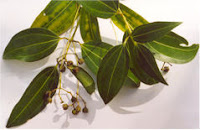 Cinnamon: Cinnamon is hardly unfamiliar, but I have never bothered to think of it beyond the powder or stick that I buy in the baking aisle or that overly pungent stuff that sears the lining of my lungs in every gift shop from now until Christmas. It's actually the inner bark of a little evergreen tree native to South India and Sri Lanka. It was so prized in ancient times that it was a gift for kings. And as trade routes broadened, entire nations fought over who would control the markets. Cinnamon has been used to ward off colds, cure diarrhea, ease tooth aches, and prevent bad breath.
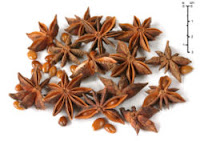 Star Anise: I have only had a few recipes that call for this, and I have yet to find it in local stores. I have to travel for it, and I have never wanted it enough for a special trip. Star anise are fruit from a small evergreen in China, harvested before they ripen between March and May and used in Chinese cuisine. I have a bottle of five-spice powder that I mostly use to season layers of filo for a kind of napoleon dessert, oddly, and I have now learned that star anise is one of the five spices. It has been used in tea as a remedy for colic and rheumatism, and it has also been a key ingredient in Tamiflu, a drug that is used to treat bird flu.
 Saffron: This one is so fascinating to me because it's so darned expensive. The harvesting process is so tedious, a small envelope of the threads can cost $15. Saffron is the dried stigma of a crocus grown in Southwest Asia, and the tiny threads have to be carefully picked by hand. It takes 50,000 to 75,000 flowers to produce a pound of dried saffron, and 40 hours of round-the-clock labor goes into picking 150,000 of the things. Its uses in history are too numerous to list here, but I will say that Alexander the Great used it to treat his battle wounds. It is sold by grade, so I assume the cheap stuff I can get at World Market is not the highest quality.
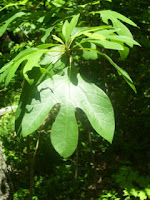 Sassafras: This one was a shocker for me. Because of my southern heritage, I grew up drinking sassafras tea and eating sassafras-flavored licorice. Years ago when my sister bought some uncultivated land, we yanked up some little sassafras trees, cut off the roots, and boiled them for our own fresh tea. What did we know? The root was used to flavor root beer until it was banned in 1960, and it is used to make the drug ecstasy. Maybe the two things are related. The FDA has banned the use of sassafras oil in food and drugs, so I assume the tea concentrate on the store shelves is made from something artificial, and I assume there is some level of risk in making my own tea.
Additional note from Sister: I did make a lot of it that summer while we were building the house. You could smell the fresh cut roots in the air after they did all the grading. I did notice that after having it for more than a day or two in a row that I got a little light headed. It sort of spooked me, so I did a little research myself. It didn’t say anything about Ecstasy (25 years ago), but it did say that sassafras tea was used as a blood thinner and that you could have too much of a good thing.
I take certain things for granted--simple ingredients that I buy in jars like cinnamon and capers--and I don't stop to think about what the heck they are. What is a caper, anyway? So, I did a little digging, and here is what I found about certain spices that don't come from the ground in glass containers.
 Capers: these are the buds of a perennial shrub that is native to the Mediterranean. They are picked ripe and then pickled in a brine or salted and sold by size--the smaller the better. Sometimes they are a substituted for olives in martinis, which is always nice. The Greeks use them to fight off rheumatism.
 Cinnamon: Cinnamon is hardly unfamiliar, but I have never bothered to think of it beyond the powder or stick that I buy in the baking aisle or that overly pungent stuff that sears the lining of my lungs in every gift shop from now until Christmas. It's actually the inner bark of a little evergreen tree native to South India and Sri Lanka. It was so prized in ancient times that it was a gift for kings. And as trade routes broadened, entire nations fought over who would control the markets. Cinnamon has been used to ward off colds, cure diarrhea, ease tooth aches, and prevent bad breath.
 Star Anise: I have only had a few recipes that call for this, and I have yet to find it in local stores. I have to travel for it, and I have never wanted it enough for a special trip. Star anise are fruit from a small evergreen in China, harvested before they ripen between March and May and used in Chinese cuisine. I have a bottle of five-spice powder that I mostly use to season layers of filo for a kind of napoleon dessert, oddly, and I have now learned that star anise is one of the five spices. It has been used in tea as a remedy for colic and rheumatism, and it has also been a key ingredient in Tamiflu, a drug that is used to treat bird flu.
 Saffron: This one is so fascinating to me because it's so darned expensive. The harvesting process is so tedious, a small envelope of the threads can cost $15. Saffron is the dried stigma of a crocus grown in Southwest Asia, and the tiny threads have to be carefully picked by hand. It takes 50,000 to 75,000 flowers to produce a pound of dried saffron, and 40 hours of round-the-clock labor goes into picking 150,000 of the things. Its uses in history are too numerous to list here, but I will say that Alexander the Great used it to treat his battle wounds. It is sold by grade, so I assume the cheap stuff I can get at World Market is not the highest quality.
 Sassafras: This one was a shocker for me. Because of my southern heritage, I grew up drinking sassafras tea and eating sassafras-flavored licorice. Years ago when my sister bought some uncultivated land, we yanked up some little sassafras trees, cut off the roots, and boiled them for our own fresh tea. What did we know? The root was used to flavor root beer until it was banned in 1960, and it is used to make the drug ecstasy. Maybe the two things are related. The FDA has banned the use of sassafras oil in food and drugs, so I assume the tea concentrate on the store shelves is made from something artificial, and I assume there is some level of risk in making my own tea.
Additional note from Sister: I did make a lot of it that summer while we were building the house. You could smell the fresh cut roots in the air after they did all the grading. I did notice that after having it for more than a day or two in a row that I got a little light headed. It sort of spooked me, so I did a little research myself. It didn’t say anything about Ecstasy (25 years ago), but it did say that sassafras tea was used as a blood thinner and that you could have too much of a good thing.
Comments
I have 5 Indian markets a block away from my house. Sometimes I go there just to smell the spices. It's comforting.
And I never knew that about sassafras either!
I forgot to burn the CD.
Great post..I can imagine cinnamon becoming more and more rare, can't you?
With commercially grown cinnamon trees, I'm not sure if there will be shortage. There are so many of those crafty sticks floating around, used for so many things besides food, I can't imagine.